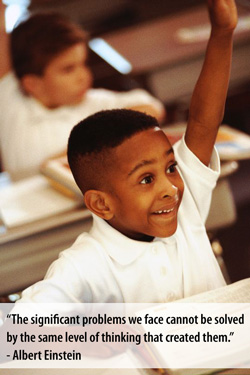

In our rapidly changing and technologically complex society, schools are being asked to educate the most diverse student body in history to higher and higher academic standards. Some students—disproportionately boys—are bored, disconnected, and underachieving. Parents worry when they see their boys arrive home from school with negative attitudes toward classroom learning. They grieve when they see the spark of enthusiasm for learning flicker and die.
 
Many people have assumed that teaching and learning are gender-neutral and free of bias, but we have recently become uncomfortably aware of ways in which differences in the cultures of masculinity and femininity influence attitudes toward teaching and learning.  Within the stability of the school structure gender biases are expressed in the power structure – in the ways that people work together and treat each other – all of which send important messages about gender expectations to both boys and girls. The versions of masculinity and femininity which are inculcated in classrooms become part of students’ social identities.
 
Experts who are not simply smitten by arguments about test score differentials and gender achievement gap have identified differences between boys and girls that go far beyond obvious biological differences.
 
Understanding the varying needs of boys is crucial for their school success.

Boys do not need excuses for bad behaviour, nor do they need rescue from their masculinity. They need respect, discipline, guidance, and understanding.  
 
How can we help boys to be more themselves without pitting their needs against the needs of girls, without ignoring those who are economically or intellectually disadvantaged or who are marginalized in other ways?
 
How can we instill in our boys a sense of community and global citizenship, healthy intellectual skepticism, respect for others, and appreciation for our abundant diversity?
 
As we consider the particular responses of schools to the varied educational needs of boys in their communities, we cannot forget the central mandate of public education: promoting critical inquiry within an inclusive and supportive community.

To arrange for a Boy Smarts educator event please contact sagepoint@telus.net


Brief excerpts from Boy Smarts – Mentoring Boys for Success at School
Copyright 2005, Barry MacDonald

Do Boys Lack Motivation?
Parents rarely complain that a zippy preschool boy lacks motivation. Young boys are propelled by curiosity, eager to explore their environment, interact with it, and make sense of it. Unfortunately, as boys get older, many begin to associate learning with drudgery. They invent multiple excuses to avoid schoolwork. In high school, some start skipping regularly and are pushed out or drop out. Parents wonder sadly why their once bright-eyed, eager boys have become so apathetic, cavalier, or even hostile toward learning.

Boys Need Understanding
Experts who have been taking a hard look at boys’ achievement are rediscovering differences between boys and girls that go far beyond obvious biological differences. Understanding the uniqueness of boys and making room for them to be themselves is crucial for their school success. Boys need love, discipline, respect, moral guidance, and understanding. They do not need to be excused for their behaviour, nor do they need to be rescued from their masculinity.

Don’t Pit Boys Against Girls
All efforts to raise the achievement of boys must be made without threatening the gains made by girls in recent years. We need to be careful not to initiate changes that will pit boys against girls, or ignore those who are truly disadvantaged. As we discuss the development of school-wide plans to raise boys’ achievement and each school’s adaptation to its particular needs, let us keep in mind the central mandate of public education: the fostering of critical inquiry within inclusive community.

Avoid Simplistic Solutions
Each community of learners is diverse. What works in a small farming community where children may be bused to school is different than the needs in a larger urban setting. What works for one school or community might not work in another. We need to steer clear of one-size-fits-all bandwagon oratory.

We must also be careful not to swing away from our concern about girls' achievement to a binary trap whereby gains made by girls are assumed to equate to losses by boys; and the problems caused by gender stereotyping.

Brain Differences
An exciting recent development is the growing recognition of the physiological differences that can occur in boys and girls' brains and the impact this can have on learning. In the last decade, medical science has made tremendous advancements in understanding how the brain works. These new insights - along with an increased understanding of how gender straitjackets inhibit children - are beginning to impact schooling. More than ever before, educators have the potential to become even more effective at reaching and teaching kids.

Researchers are now able to monitor and observe brain activity as no other time in history. From this, we have learned that there are some important variations in male and female tendencies regarding the physiology, development, structure, and hormonal influences of the brain. Understanding how boys learn has the potential to change how we view boys in the classroom, how we can improve their learning experiences, and how we can lessen problems with their behaviour and disengagement with school.

Anatomy is NOT Destiny
At the same time we should avoid overgeneralizations about boys as a group. The biological determinism argument – also known as anatomy is destiny – can be invoked to support facile generalizations. People may assume that certain behaviours are justified and unchangeable because boys will be boys. There is little consideration of the wide variety of behaviours among members of each gender or how actual males and females may relate to each other in different settings.

In our current recognition that boys are struggling within the educational system, there is a danger of portraying boys as a homogeneous group of underachievers who are victims of a female-gender bias in our classrooms. Viewing boys as disadvantaged from the beginning or blaming teachers for creating feminized classrooms fuels a sense of helplessness.

Thinking that there is nothing we can do to help our boys achieve may lead us to the unproductive place of leaving them alone. It is important to remember that each boy responds from his genetic blueprint in a unique and individual way that involves a complex interplay of biology, culture, and personal meaning making. Just as being the eldest in a family does not automatically translate into bossy behaviour, findings about brain differences in males and females does not automatically mean all boys and all girls learn in the same way.

The Culture of Masculinity
Today’s popular culture often seems pumped on steroids, filled with meaningless excitation, overwhelming angst, and frenetic speed. According to film critic Michael Medved, in the early sixties the TV camera lingered on one scene an average of 45 seconds, whereas today the average is a maximum of 3 to 5 seconds per scene.

Before Kindergarten even starts, boys come to school after having watched thousands of hours of flashing cartoons and shows that jump from one scene to the next in rapid succession. The media glamorizes laziness and rudeness. It also sells violence, dehumanized sex, and materialism on a daily basis to our boys. It portrays a false perfectionism and an exciting extremism that can rarely be attained in life even to our very young.

Messages from their families, peers, and the media seduce, complicate, and confuse boys as they struggle to make sense of what their masculinity means in the world.

Recognize Unique Expressions of Gender
Many people have assumed that teaching and learning are gender-neutral and free of bias, but we have recently become uncomfortably aware of how much differences in the cultures of masculinity and femininity influence our attitudes toward teaching and learning. Within the stability of the school structure gender biases are expressed in the power structure – how people work together and treat each other – all of which send important messages about gender expectations to both boys and girls.

At schools we are challenged to provide activities that appeal to boys across the whole continuum of gender. Not all boys want to become hockey stars. Not all boys dislike reading. Not all boys seek thrills and physical challenges. Rather than assume boys benefit from more rough and tumble activities, we could provide a range of activities for boys reflecting their varied needs - for reflection as well as for rambunctious play. It is important to remember that many boys need quieter activities such chess, model building, and reading clubs.

Learning is Not a Spectator Sport
Most educators acknowledge that the restless children are often boys; bright ones, quiet ones, boisterous ones, and misbehaving ones. We need to provide them with effective and affirming ways to use their energy.

To sit and listen just isn’t engaging enough. Boys need to utilize all their senses as they interact with the world. Walking, talking, drawing, writing, laughing, singing, acting about what they are learning, relating it to past experiences, and applying it to their daily lives keeps learning alive and motivating. Movement strengthens the development of neurons and encapsulates information in the brain so it can be recalled more easily later. Active learning helps kids to take ownership for what they learn because they put their whole self into it and as a result make it a part of themselves.

Focus on Boys’ Strengths
Teaching and parenting children – boys and girls – are great privileges, and great challenges. Boys have unique gifts and talents. If we allow ourselves to learn about boys' special strengths and abilities, we can begin to imagine how we might better meet their learning needs, helping them to engage more fully in school, and guiding them to develop a lifelong interest for learning.

Positive change begins by capitalizing on strengths and past success. Understanding a boy's talents and how to mentor these talents is the central endeavor of Boy Smarts - Mentoring Boys for Success at School.

All Hands on Deck!
Admitting that there is a problem is an important place to begin. During the last five decades of social change, schools have been asked to shoulder more and more of the burden of responsibility. Despite schools being the focal point in children’s lives, they cannot be a panacea for all social problems, or address every developmental need that children bring with them to school. We need the meaningful involvement of the larger community. Children learn best when the significant adults in their lives – teachers, parents, family, and community members – work together to encourage and support them.

To address the underachievement of boys and girls, we need a holistic approach. We need to bring all of ourselves to the critical work of mentoring the next generation. Yes, we need practical strategies and knowledge about best teaching practices. We also need imagination, and the courage that comes from the heart.


“We must help boys to use their time, energy, and talents in positive and contributory ways – it’s that simple.  Boy Smarts and its accompanying Boy Smarts Action Study Guide provide perceptive and thoughtful points of inquiry for learning communities to accomplish this goal with boys of all ages and from all walks of life.  It lays the foundation for constructive and positive futures.”

 – Marilyn McGuire, Seattle

International Consultant, Former Principal, Author, Gangs and Violence: School-wide Strategies for Prevention and Intervention


To arrange for a Boy Smarts educator event please contact sagepoint@telus.net


Teacher appreciates balanced approach...

As a parent and teacher I found your engaging presentation to be a real eye opener. I loved it!

I grew up in a home with my mom, my sisters and myself, and I certainly wish I had been to your talk and read Boy Smarts as a beginning teacher!

I found myself struggling with boys who fidgeted, were constantly moving, and had difficulty paying attention at circle time.

It wasn¹t until your talk last week that I really understood how spatial some boy¹s brains are ­ and some girls for that matter.

I personally don't like visual puzzles and still have difficulty figuring out who got to the 4-way stop intersection first. I have been astonished by how little verbal instructions some boys need. I now understand why some boys and girls got lost in my lengthy instructions.

Although I learned a lot in those early years of teaching, I still wasn't completely prepared to become a parent of three loud and rambunctious boys, with the two youngest as twins! Our family life has certainly had its moments.

While I am grateful that many boys have "spider senses" and are comfortable with eye contact, my boys, and I'd guess about half of the boys I teach, seem not to.

Your comments about how managing anxiety varies with each person encouraged me to be more observant of my own eye contact.

I found your comments about the gender gap particularly useful as a teacher.

While you smartly didn't support the popular notion that all boys are underachieving or suggest a one size fits all to remedy a situation that clearly does not exist, you asked questions that really got me thinking.

You helped me to understand that genders don¹t come from Venus and Mars and yet there are tendencies to be aware of.

Some of the books I¹ve read claim that boys and girls learn differently or that they are victims of our macho culture and need rescuing. Your notion of the gender continuum (you also referred to it as a gender matrix) side-stepped stereotypes and conceptualized gender in such a practical way for me.

Your broad spectrum view opens up this politically hot topic in a way that brings sensitivity and appreciation for our rich diversity as humans.

I am looking forward to participating in an after school discussion group with colleagues using your latest book, Boy Smarts Action Study Guide to consider the 100 guidelines outlined in Boy Smarts.

Thank you for being a champion for boys while also respecting girls' needs and advocating for all kids. You have reminded me why I love teaching!

Monique,
Toronto



Name Email City Country
Home | Boy Smarts | Barry MacDonald | Success | Literacy | Parenting | Schooling | Toolbox | Events | Summer Institutes | Contact
© 2007-08 Mentoring Boys - Barry MacDonald. All rights reserved.
Website design by Fresh Marketing
Mentoring Boys Home Send An Email About Mentoring Boys the Book Summer Institute Boy Smarts Barry MacDonald Success Services Parenting Schooling Toolbox Events For Parents & Teachers Summer Institutes